Lottie’s recurrent heart crises
All My Puny SorrowsLottie’s recurrent heart crises turn emergency care into a recurring part of family life: each episode brings the possibility of losing her, but also another return to the people gathered around her. The Christmas Eve crisis is treated urgently and her life is saved; by the next day, she is already making fellow patients laugh. The pattern gives the family’s fear a familiar setting without making it routine in any simple sense.
The Christmas Eve Emergency
On Christmas Eve, the narrator is reading in Lottie’s living room while other family members are away or occupied: Will and Zoe have left for Mexico City, Nic is in Montreal, and Nora is speaking by video with Anders in Stockholm. Lottie lies near the Christmas tree, and her breathing changes and becomes shallow. The narrator recognizes the severity of her condition, calls an ambulance, and accompanies her to hospital.
Emergency treatment saves Lottie’s life again. The account names chest compressions and nitroglycerine among the interventions, describing medication used to ease the strain on her heart. The word again matters: this is not presented as the first crisis, but as another episode in a family history of urgent journeys to hospital. The Christmas setting makes the emergency a sudden interruption of an ordinary domestic scene, while the outcome returns Lottie to the family’s care.
Humor and the Hospital
Even in the ambulance, Lottie responds with a joke about how the event would unsettle her daughter’s household preserves. A paramedic asks her to repeat it so he can share it with his friends. Her humor does not erase the danger; it becomes one of the ways she meets it, and the moment lets the people around her recognize her familiar voice amid the emergency.
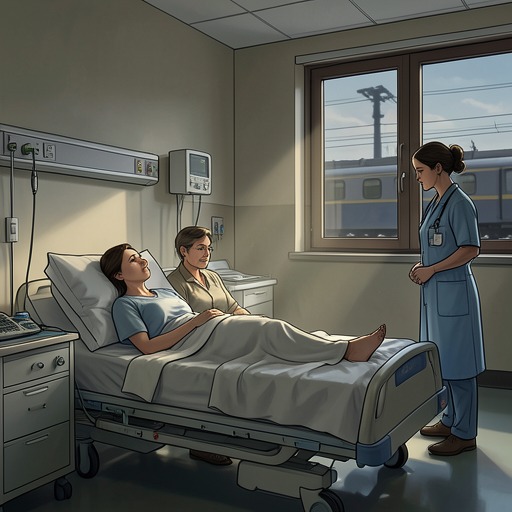
At the hospital, the narrator distinguishes Lottie’s cardiac emergency from Elfrieda Von Riesen’s psychiatric hospitalization. Lottie is treated as a cardiac patient, and the episode is not accompanied by the disciplinary lectures the narrator associates with Elfrieda’s care. Nora joins the narrator beside Lottie’s bed, where Lottie is behind a curtain and connected to hospital equipment. When she wakes, she remarks on the timing of the crisis, then tells them she has dreamt of Amelia Earhart. Her dream leads briefly to a conversation about the famous missing pilot; Lottie cries for a few seconds and apologizes for spending Christmas in hospital. Her family reassures her that the interruption does not matter, and Nora suggests celebrating with the Ukrainians at another time.
Christmas at Her Bedside
A neighbor, Amy, arrives with food, wine, cloth napkins, china, and silverware. The family arranges its Christmas Eve dinner at the hospital, turning Lottie’s bedside into the center of the celebration. Nora helps her take a sip of her drink, and the family shares champagne in plastic sample cups. They toast to themselves and to absent or deceased relatives, including Elfrieda, their father, Aunt Tina, and Leni, and sing Lottie’s favorite Christmas song, I Wonder as I Wander. The meal gathers several kinds of family memory around her: present-day care, holiday ritual, and acknowledgment of those who are gone.
This scene makes Lottie more than the recipient of care. The narrator presents her as the family’s table, the figure around whom people assemble, even when illness relocates the gathering to Emergency. The hospital does not restore an undisturbed holiday, but the family adapts its celebration to the place where Lottie is being treated. Their response is practical and affectionate rather than solemn: food is brought in, a toast is made, and the song continues the family’s Christmas tradition.
Recurrence and Its Meaning
The day after the emergency, Lottie has already made friends among the other patients and is entertaining them with anecdotes from behind her curtain. The narrator says that Lottie is always dying, at least once a year, and compares her repeated appearances in emergency rooms to a stand-up comedian touring from Puerto Vallarta and Cairo to Winnipeg and Tucson and Toronto. The line compresses fear and familiarity into a comic image: the crises recur, but Lottie’s wit and sociability recur with them.
That description does not make the episodes harmless. On Christmas Eve, the narrator believes Lottie is dying and summons help; the hospital saves her life again. Rather, the repeated pattern shows how the family lives alongside uncertainty. Each crisis interrupts ordinary plans and demands immediate action, then leaves room for reunion, food, conversation, and humor. Lottie’s recurrent heart crises therefore mark both the precariousness of her survival and the persistence of the family’s shared life around her.